Digitized from original source held at University of Florida Libraries.
Showing posts with label rhyming text. Show all posts
Monday, March 28, 2011
PUBLIC DOMAIN MONDAY: THE 3 LITTLE KITTENS
Digitized from original source held at University of Florida Libraries.
Labels:
animals,
kittens,
rhyming text
Tuesday, March 8, 2011
GOOD BOOKS FOR CHILDREN WITH DEVELOPMENTAL DISABILITES
Reading aloud to children helps with language development and literacy, as well as listening skills. This can be especially important for kids with various developmental disabilities, including ASD (Autism Spectrum Disorder), because understanding and using language can be very difficult for them.Dr. Monica Ultmann has created a "Developmental Disabilities Literacy Promotion Guide", that can be obtained here at ReachOutAndRead.org. This guide (specific to seven different disabilities) includes handouts, activities and reading tips, suggested books, and lists of resources for parents.
CLICK HERE for the "Doctor Recommended Book List" for children who suffer from developmental disabilities...the seven that are addressed include: Speech and Language Problems; Autism Spectrum Disorder; Intellectual Disabilities (mental retardation); Inattention and Attention Deficit/Hyperactivity Disorder; Cerebral Palsy; and Vision and Hearing Impairments.

A CLOSER LOOK AT AUTISM & READING
As a follow-up to my post on Library Story Time for Autistic Readers, I want to highlight some specifics about Autism Spectrum Disorder and how books can help. ASD impacts the way children react to situations and people. Children with Autism often have trouble making eye contact and sharing their thoughts with words or gestures. Non-verbal communication is especially difficult for a child on the autistic spectrum. Body language, gesture and facial expressions are not understood as clues to communication.
TIPS FROM REACH OUT AND READ:
Borrow books from the library that have photos and drawings of babies and people’s faces. This can help your child recognize emotions.
Read the same story again and again. The repetition will help her learn language.
Read aloud. Talk about the pictures and read the text.
Find books that have lots of repetition of phrases. Also find books with rhymes. Softly clap your hands and help your baby clap along to the rhythm.
Find books that have buttons your child can press that have sounds.
PREDICTABLE STORIES ARE IMPORTANT:
"Predictable books play an important role in developing early language and literacy skills for infants and toddlers (Miller, 2000). Books that allow children to guess what will happen next in the story, books that provide repetitive catch phrases (e.g., Brown Bear, Brown Bear, What Do You See
and books with a predictable rhyme pattern (e.g., Fox in Sox
All books become somewhat predictable with repeated readings and children enjoy hearing them over and over again. Books with familiar sequences and those in which pictures exactly match the text are usually predictable for children. Predictable books provide the emergent reader with a satisfying and enjoyable first experience." -from the article Birth to Three: Building a Foundation for Literacy, SpeechPathology.com
Even MORE book recommendations...from AbilityPath.org
Leave a comment to let me know your favorites!
Wednesday, December 15, 2010
A PARADOXICAL SETTING FOR THE BIRTH OF A KING!
CHRISTMAS NIGHT, FAIR AND BRIGHT
by Julie Stiegemeyer, illustrations by Melissa Iwai. (ages 3-7). If you're looking for a book that emphasizes the true meaning of Christmas for even the youngest of children, look no farther!

In simple rhyming words, Julie Stiegemeyer expertly recreates the sights and sounds of the first Christmas and at the same time, emphasizes the two natures of Christ -- His abject humility in his simple birth and His ultimate divinity as our King and Saviour. With each verse, Jesus' perfect life and death on our behalf is communicated: "Jesus, born for us."
Most of this telling takes place in the humble stall -- the paradoxical setting for the birth of the King of kings and the Lord of lords:
This book predictably recounts the events of that first Christmas, but it includes the flight to Egypt as well. It also alludes to the crucifixion. Melissa Iwai's illustrations are perfect for the 3-7 age group. Her brightly colored images have less detail than those for older children, but still capture the drama and reality of the events on that dark night in Bethlehem, when Christ, the Light of the World, was born.
To see more books by Julie Stiegemeyer, click here.
In simple rhyming words, Julie Stiegemeyer expertly recreates the sights and sounds of the first Christmas and at the same time, emphasizes the two natures of Christ -- His abject humility in his simple birth and His ultimate divinity as our King and Saviour. With each verse, Jesus' perfect life and death on our behalf is communicated: "Jesus, born for us."
Most of this telling takes place in the humble stall -- the paradoxical setting for the birth of the King of kings and the Lord of lords:
Frankincense hangs in the air.
Stars are twinkling everywhere.
A child is born beyond compare -
Jesus, born for us.
Jesus has no kingly hall.
Jesus has no fortress tall.
Home becomes a cattle stall
for Jesus, born for us.
So sequined stars become a crown,
night, a robe to wrap around;
God's own Son to earth came down.
He's Jesus, born for us."
This book predictably recounts the events of that first Christmas, but it includes the flight to Egypt as well. It also alludes to the crucifixion. Melissa Iwai's illustrations are perfect for the 3-7 age group. Her brightly colored images have less detail than those for older children, but still capture the drama and reality of the events on that dark night in Bethlehem, when Christ, the Light of the World, was born.
To see more books by Julie Stiegemeyer, click here.
Labels:
Christmas,
family reading,
Nativity,
read aloud books,
rhyming text
Tuesday, November 2, 2010
POETRY: "SERIOUS PLAY"
"Play is what we want to do. Work is what we have to do...poetry is both of those things. Robert Frost, in fact, defined poetry as 'serious play'. Poetry is the liveliest use of language, and nobody knows more instinctively how to take delight in that playfulness than children..." (Academy of American Poets - poets.org)
The ancient Greek word for poetry (poesis) is translated "to create". Like me, maybe you haven't really considered the definition and origin of poetry since that last literature class you took in college. I found a comprehensive, yet brief and interesting explanation of "WHAT IS POETRY" here.
Poetry, with its rhythm and rhyme, is perfect for reading aloud, and is very easy for children to memorize. It does not always have to rhyme, but it is always about expression and emotion. Parents and teachers need to search for fun, thoughtful, and creative poems that will set children on the road to appreciating this literary art. (If you're interested in poetry for babies and toddlers, you can read my earlier post about Mother Goose Rhymes).
There are classic poets, such as Edward Lear, Robert Louis Stevenson, Jane Taylor, A.A. Milne, and Christina Rossetti, whose long-cherished works will help paint wonderful pictures on the canvas of your child's imagination...
WHO HAS SEEN THE WIND? by Christina Rossetti
Who has seen the wind?
Neither I nor you:
But when the leaves hang trembling
The wind is passing thro'.
Who has seen the wind?
Neither you nor I:
But when the trees bow down their heads
The wind is passing by.
Click here to see and read the Lulu.Poetry list of Greatest Children's Poems Ever Written.
And go to Classic Children's Poems to download free poetry for parents and teachers.
ANTHOLOGIES for ages 4 and up:
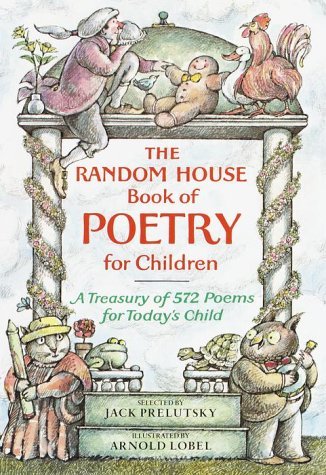
THE RANDOM HOUSE BOOK OF POETRY FOR CHILDREN
, compiled by Jack Prelutsky. Illustrations by Arnold Lobel.
TALKING LIKE THE RAIN, compiled by X.J. Kennedy and Dorothy M. Kennedy. Illustrations by Jane Dyer.


ELOISE WILKIN'S POEMS TO READ TO THE VERY YOUNG
, compiled and illustrated by Eloise Wilkin.

The ancient Greek word for poetry (poesis) is translated "to create". Like me, maybe you haven't really considered the definition and origin of poetry since that last literature class you took in college. I found a comprehensive, yet brief and interesting explanation of "WHAT IS POETRY" here.
Poetry, with its rhythm and rhyme, is perfect for reading aloud, and is very easy for children to memorize. It does not always have to rhyme, but it is always about expression and emotion. Parents and teachers need to search for fun, thoughtful, and creative poems that will set children on the road to appreciating this literary art. (If you're interested in poetry for babies and toddlers, you can read my earlier post about Mother Goose Rhymes).
There are classic poets, such as Edward Lear, Robert Louis Stevenson, Jane Taylor, A.A. Milne, and Christina Rossetti, whose long-cherished works will help paint wonderful pictures on the canvas of your child's imagination...
WHO HAS SEEN THE WIND? by Christina Rossetti
Who has seen the wind?
Neither I nor you:
But when the leaves hang trembling
The wind is passing thro'.
Who has seen the wind?
Neither you nor I:
But when the trees bow down their heads
The wind is passing by.
We can also introduce our kids to modern poets, including Jack Prelutsky, Shel Silverstein, and Tony Mitton, to name a few. Jim Trelease comments, from his READ ALOUD HANDBOOK:
One of poetry's strengths is its brevity. A poem is not a novel or a short story, yet it can be very revealing in its smallness--like one of those see-through Easter eggs. A poem should add up to something, a slice of life. One expert put it this way: "Unless a poem says something to a child, tells him a story, titillates his ego, strikes up a happy recollection, bumps his funny bone--in other words, delights him--he will not be attracted to poetry regardless of the language it uses."
Click here to see and read the Lulu.Poetry list of Greatest Children's Poems Ever Written.
And go to Classic Children's Poems to download free poetry for parents and teachers.
ANTHOLOGIES for ages 4 and up:
THE RANDOM HOUSE BOOK OF POETRY FOR CHILDREN
TALKING LIKE THE RAIN, compiled by X.J. Kennedy and Dorothy M. Kennedy. Illustrations by Jane Dyer.
ELOISE WILKIN'S POEMS TO READ TO THE VERY YOUNG
Monday, September 20, 2010
JUST FOR FUN: SOME ENTERTAINING READ ALOUDS WHEN KIDS ARE SICK
I recently came across two very entertaining books. They are perfect choices for reading aloud to a sick child, who is bored in bed and needing some cheering up.
The first book is an older classic - one of those "just for fun" books that sparks the imagination. Like the boy in the story, your child may want to get busy with A BIG BALL OF STRING
Told in rhyming text, it's the story of a boy who starts collecting pieces of string... "I had a little string. It was no good at all. I went to look for more string to make a string ball." When he comes down with a cold and finds himself sick in bed, he keeps himself occupied by thinking up things to do with the string: "I can look at my book! I can shoot with my gun! I make my bell ring! I can make my train run!"
| Who knew what a fun investment a ball of string could be? |
The second "just for fun" book I'd like to mention, was recommended to me by a friend and her avid library-going preschooler. It's a newer book: RHYMING DUST BUNNIESThis is one of the silliest and funniest books I've ever come across. It's about three Dust Bunnies who are having fun rhyming. A fourth friend, "BOB", just doesn't quite seem to catch on. They don't understand his offering of, "Look!", in their attempt to rhyme, "far, jar, and tar" with "car". And when they try to rhyme "bug": "rug...hug...mug", his response is, "Look out!" Assuming he's just rhyme challenged, but not realizing he's simply warning them about an approaching "monster with a broom" (a vaccum), they get swept along and...well, you'll have to go find the book to see how the hilarity ends!

Jan Thomas has written and illustrated several other picture books that are just as fun!
Labels:
Jan Thomas,
rhyming text
Subscribe to:
Posts (Atom)